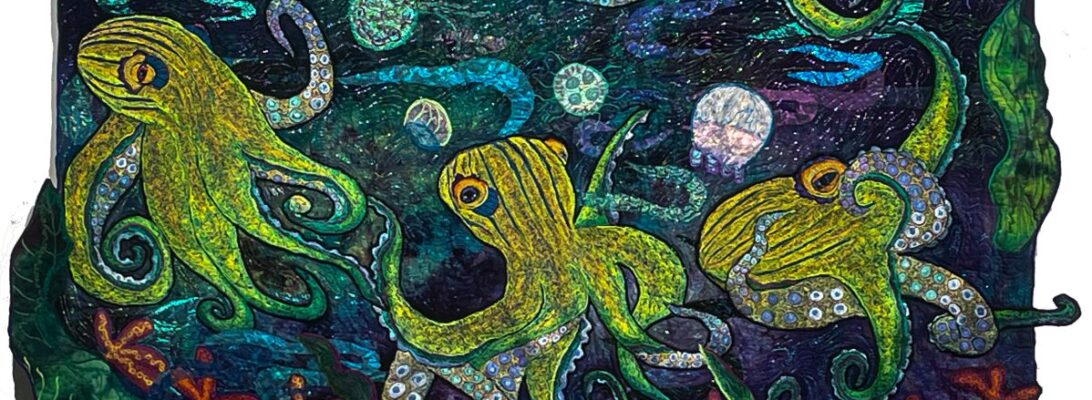
I’m worn out after doing a bunch of big pieces. Big is of course, relative. I consider anything past 33″ x 43″ largish. I like workin that size. But the last ones have stretched larger, and I’m tired of shoving large wads of fabric through the machine.
I’ve been working on a white garden piece. The idea came fromThe White Garden, a speculative fiction about Virginia Wolf. She was thinking about an all white garden for the blackout, so that the moon would show on the white petals. I found some embossing plates that were wonderful prarie grasses. I put them on dark blue hand dye in shades of white and blue.
I’ve never had the dicipline to plant only white flowers. Too much of a color junkie. But I love the idea.
This is a visual path piece. It’s about 12″ x 45″ So everything has to be tiny.
So I made a strip of white and pale flowers. But then it needed moonlight and bugs. No one said the bugs had to be white.
How is tiny embroidery different than large pieces. Several things work differently. First off, I want to avoid a thick outline. So instead of embroidering on a sandwich of hand-dye, felt, stitch and tear, and totally stable, I left out the hand dye, and embroidered on the felt instead. Since I wqs using black outlines, I used black felt. Using felt reduces the bulk, but I found it could not be ripped out or sewn over. This is partially why I made a lot more bugs than I would need.
I could have embroidered tiny pieces within the piece. But I chose not to this time. It still makes for a lot of distortion. So I did a batch of moths, fireflies, snails and rocks.
Embroidering tiny pieces insists upon simplification. The usual shocker-shader colors are too much. A simple range works better: gold and green, white and blue, green and blue.
The fireflies are also mostly unshaded. There’s no room for anything except the primary colors of red and green.
So my white garden is full of wild color, very tiny bugs. I think I could find my way in it.
Just like I’m not a desert girl, I’m not a rock girl either. I don’t think in terms of dry. As an artist it’s always good to stretch past what you know how to do.
For the longest time, I’ve cut rocks out of hand dye, and been satisfied with them. But I really wanted to do a waterfall with carp. And you can’t have a waterfall without somewhere from the water to fall from. That would be rocks.
I put up some cut grey and brown rocks and looked at them. They looked hopelessly childish and wrong.
It’s a bad moment. It’s also a great invitation. You dig deep, you look at it in different ways, and try to morph what you already know into what you need to do next.
That sent me spinning off to my library to look at how other people handle rocks. I have a book of Elizabeth Doolittle that’s full of great mountain imagery. And a great book on Glacier National Park with some fabulous waterfalls.
The real treasure was my Mustard Seed Garden Manual of Painting, the classic sumi painting text. It said that trees were all about the veins in the leaves, but that rocks were about the grain in the rocks.
I thought about that for a while. Then I realized, the occlusions in the hand dye are the grains in the rock.
I replanned the rocks for the waterfall. Instead of making strips of rocks, I cut chunks. I filled in areas with smaller rocks and gravel.
Then I texturized the rocks, putting on a dark under edge and shading at the bottom third, and followed the patterns of the hand dye as grain. I used black thread and a zigzag stitch to establish the bottom of the rock and then shaded with a long-short stitch. Finally I followed the grain of the rock using the elements of the hand dye. Since I did a lot of stitching, I made them separate from the piece on stitch and tear and felt as stabilizers.
I’m still unsure. But I’m closer. I need to make the rocks that define the pond underneath and sort out the waterfall, but I think it’s on its way.
These rocks need to be less regular. I tried to use perspective to determine the shading, but simple shading seemed to work better.
It’s a slower process. I’m stymied on the desert quilt while I’m waiting for the books I ordered to figure out sand textures. It’s not just sewing, it’s thinking.
What do you think? Are these rocks over-fussy, or do they add the right amount of texture.?
I’ve been working on a koi fish quilt for a while. I wanted those heavily scaled koi with repetitive black background under orange-red scales. If it sounds easy, I’m saying it wrong.
This is a zoning issue. You have a black zone and a colored scale zone. They need to be crisply separated.
The gold standard approach is to make each scale separately, tie them off, and start the next one. By one. By one.
It does make a nice separation. It also asks the question, “How long do you expect to live?” It takes forever.
The other answer is to do one zone at a time and find a pathway through your stitching that makes the least mess getting from one spot to another. You need to find a stitching pattern.
It’s different every time. You want to cover the areas where you’re moving from one square to another with the smallest, least visible stitch.
What works best is the stitch moving your zigzag directly out from the side. You’ll get a straight line that later can be covered over. Or if it’s tiny enough, ignored.
I chose to take black thread afterward and clean up the image. This is half fixed, half not. I’m sure you can see the difference.
It’s always simpler to blend colors. But sometimes what you want is that crisp distinction between zones.
This week I painted a batch of lace and organza. I love using these soft laces because they offer texture and shifting color as another overlay on the surface.
These are not especially elegant laces. The organza is plain poly organza. I often find them in rummage sales. I hit the jackpot at some point when I bought a pile of remanents from a wedding seamstress.
Painting lace is easy. I use acrylic paints from Walmart or Joann’s and mix them with fabric media (available at Amazon) to make the hand of the fabric better. Mix in a little extra water until the paint is the consistency of cream, and paint the lace with sponge brushes. It’s a lovely, messy wildly colored afternoon. You let it dry completely and iron it on a synthetic heat setting.
I’ve heard a lot of people argue for the real thing. Silk organza. Real lace. I love those things too, but it’s not about fiber content. It’s about color, transparency, translucency, and texture. And it’s about whether they work well under the needle and as applique. It helps to know the content so you don’t burn it under the iron.
There’s a short story by Henry James called The Real Thing. It’s about an artist who has a noble couple offer themselves as models. They argue that they are the real thing and that they will add accuracy to his work as his models. But the truth is, he finds the woman who is his ordinary model from a humble and somewhat criminal life could be anything: a gypsy, a fairy, a queen, a courtesan, or a saint. And since she can be anything, she makes his artwork ultimately real.
Painted lace is a test tube baby, made of nylon and polyester. But it creates a wonderful surface overlay. And I really don’t care how real it is.
So, if you know of anyone who is rehoming white poly lace and organza, let me know. I finally used up my stash.
I spent yesterday in a whirlwind of classroom at the Peoria Art Guild. The Guild supports a number of artists in so many ways. But one of the things they do each year is give a handful of teens an art immersion experience, with all kinds of working art and artists.
It was a privilege. It made me wonder. These kids are 14-17, maybe. But they’re already there. They know they’re doing art and they are unabashed about it. And what they could learn in technique is more than made up for by their passion, their courage, and their already formed vision. They spent 5 hours building images in sheers and hand dye. That may have been new to them. But the creative spark is something they are already solidly committed to. It was a delight to see them work. I’ll be back in two weeks and we’ll do the stitching part of it.
When does that switch happen? I run into a lot of people who tell me they aren’t artists. Usually, that’s because they’re more verbal than visual. If you talk with them they can explain their images and the concepts in a way that brims with art.
Perhaps the problem is how do we define art?. If it has to be set in a mold, like figure drawing, or landscapes, that’s a pretty big limit on a much wider world.
But if art is, vision out of chaos., order out of disaster, and the creation of beauty and sense in the retelling of ourselves., that may be where my definition hovers. Art is life. The way we live creates our own beauty, our own songs, soothes our worst fears, and helps us to see ourselves in a different mirror that focuses on our strengths and beauty, instead of our failures and misgivings.
Art simply flows out of that. The things we produce our wonderful. But they are largely the byproduct of the process of restructuring who we are through our imagery. These kids already have it. I believe we all do, from birth.
ThePeoria Art Guild is a haven for artists and people who love and live art. You’ll find it at
It’s always nice to find a new use for an old tool. I’ve loved oil paint sticks for years. I use them for fabric rubbings and find them an exciting way to design.
I’d pulled some out for a friend who had come to the studio for a visit. They were still on my table, and as I went to put them away, I thought about lace and organza.
painted organza
I’ve painted lace before. Almost all the lace I’ve worked with has been polyester or nylon, so you had to paint it with acrylic paint, the kind that comes in little bottles at Joann’s and Walmart. You mix the paint with water and with fiber medium. Then you can paint it with sponge brushes. The effect is a soft spread of colors with a kind of plastic-like hand, that you can iron, and iron on things.
It’s pretty. But it’s always pastel. You know how I feel about pastels. Yes, there’s a reason for them. I still have to be talked into it.
So I thought about a white piece of lace I bought a while back at a garage sale, and painted bits of it with oil paint stick.
Tips for Working with Oil Paint Stick
Use a sheet of freezer paper to protect your table,.
Peel off the skin on the paint stick with a potato peeler.
Peeling along the long side of the paint stick gives a wider brush stroke.
They can be rubbed against a surface and blended with each other.
The differences are stunning. Both are cool, but in very different ways.
Oil Paint Stick
Has incredible bright color
Won’t spill
Uses up quite a bit of paint for one piece
Takes time to dry
Doesn’t need brushes
Cleans up with Goop or Go Jo
Only paints on one sided
Sets with a hot iron
Acrylic Painted Lace
Paints up with sponge brushes
Drip dries within a couple hours.
Sets with a hot iron.
Pastel to moderate color
Will I use them both. Of course! I love using sheers, and colored sheers give me a way to shift the color of my quilt surface. Having a bright option instead of just a pastel one is a big present under the tree.
Hand dye with oil paint stick lace overlay
I’m working on an ibis that needs a small pond from above and some clouds. New shaded grey/blue/beige laces might be what that needs. I love new toys!
This has been a tough week. I couldn’t get in to the studio regularly. My cardiac surgeon called to tell me he’s leaving his practice, and referring me to another doctor. And I had a friend die.
Trish Williams was an excellent fiber artist, a skilled quilter, and an astonishing story teller. She covered the black experience in her quilts in a way that drew you in and held you there, helped you to understand what had happened and how it felt. I was privileged to know her through Dana Baldwin and through the Peoria Art Guild. She died this week. I will never forget her work. I will never forget her.
What do we leave behind as artists? We leave a pile of art behind. Pictures, photos, quilts, it really doesn’t matter what the media is. You might think bei ng an artist is about artwork. I don’t really think it is. I think it’s about expressing what we see, our vision. We take what we see, we work with the images to retell our stories, to reinvent ourselves. And as we reinvent ourselves, sometimes, if you’re lucky, good or wise, sometimes we shift the world.
We also collect skills. Build new technology. Recover old technology. Open new doors. Pry open old ones gone and past. Take our own journies. Help eachother on their ways. Pass on what we know, about art, about stories about life. But it’s all in the end, a retelling of who we are, what we’ve seen and what we need.The artwork is a byproduct from the process.
Trish did all of that. You can see some of her magnificent work on her blog at https://trishwilliamshandworks.blogspot.com/. I figure God will put her in charge of directing sunsets, and I look forward to seeing her work.
I hope you will forgive a tech blog today. I’ve been unable to reach the studio for several days this week and I don’t have the normal weeks’ process to show you.
While I was working on all those silk leaves I added a candle to my studio.
Don was appalled. And he’s right. Fabric and fire don’t mix.
But fire does bring everything to its elements.
Silk leaves aren’t silk. They’re usually polyester of some sort. I can’t bring myself to care about that. They’re too pretty.
I was cutting the leaves apart to make smaller leaves. Of course, on the better quality leaves they heat the edges so they melt a little and don’t fray. I set up a candle to melt the edges of the parts I cut.
Boy, does polyester burn. Really fast, too. I set my candle in a container, put the candle into a tray of water, and ran the leaf edges through the flames. If they started to burn, I could drop the leaves into the water as a safety thing. You can hold the leaves with tweezers, but you still can’t control them once they start to burn. Being poly, they drip dry with their edges fused. If they blacken a bit, it makes them even more like fall leaves.
The same setup for this makes it safe to burn test fabric as well.
Burn testing has been around forever. It’s hard to tell fibers just by feel. Even if you’re very experienced. If you burn a small sample you can tell at once a lot about the fiber the fabric is made from.
Cotton burns to a soft fine white ash. Rayon burns black but also has a soft ash. Wool stinks like burnt hair. Polyester usually melts to a hard black edge. Nylon melts to a hard white edge. Silk burns to a hard crunchy edge.
It’s not foolproof, but it does tell you the most important thing about fiber. Is it plant, animal, or vegetable? Why does that matter?
It answers questions: will it dye? Will it fade? Will it shrink? Will it melt? You don’t need precision for that. You need to know if it’s synthetic or natural.
Synthetics, nylon, or poly will melt. They won’t shrink, bleed or fade. But they can’t be dyed except with dyes, especially for them.
Cotton, linen, bamboo, and rayon are all plant fibers. They dye beautifully with fiber-reactive dyes. But they may shrink, bleed, and fade.
Wool and silk are animal fibers. They can be dyed with certain dyes. They also shrink, bleed, and fade.
As they say, knowledge is power. Most of the time there’s a content listed on the bolt. Except when there isn’t, or it comes to you as a scrap. If you know what your fabric will do, you know how best to use it.
The same method I used for burning leaves, works with a burn test. A candle in a tray of water makes it safe. If it gets out of control you just drop it into the water.
Stay safe wherever you are! The snow has to melt sometime.